Saving to Inve$t

Helping You Save and Make Money in Today's Economy

Thinking of Reducing my 401K Contributions  

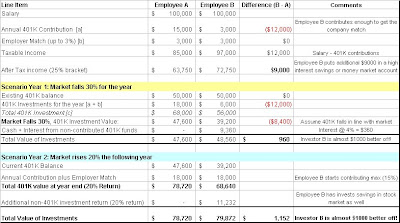
I am going to take a contrarian view of retirement savings and say that in current market conditions you should think about reducing your 401K contributions to only invest the amount that is needed to get your company match. I am normally a strong proponent of company sponsored 401K and traditional (IRA) retirement plans because of the tax advantages and long term compounding benefits. However in already depressed markets, that are set for further falls in the year ahead, minimizing your 401K contributions may be a smarter investment move overall. Don't believe me? Here's an example using two employees earning $100,000 with different 401K contribution levels, and a look at their returns after one year if the market and the value of their investments fall 30% followed by a rise in the subsequent year. To simplify things assume that they have no other investments or deductions. (click on graphic to enlarge)


From the above calculations, you can see that Employee/Investor B is almost $1000 better off when the market falls and when the market rises. Now $1000 may not be a lot of money if you are earning $100,000 but it is cash in hand, which can be especially helpful in today's market environment. More than the bailout plan or any other government intervention, 401K and retirements funds are the only game in town buying shares today and keeping the market stable. These retirement funds have to buy stocks to stay in adherence with their plan and asset allocation guidelines. So basically by contributing to your 401K you are providing sellers the ability to get rid of their stocks and taking the losses as the market continues to fall. Without 401K plans, the Dow Jones market average would probably be around 6000 today. That's why investors and Wall street firms should be thanking employees (and not the government) for continuing to contribute to their 401K and IRA plans, despite seeing them dropping precipitously in value.

I am not suggesting that you stop 401K contributions permanently. Once the stock market shows signs of life and the markets stabilize, you must ratchet those 401K investments back up to the maximum and enjoy the benefits of dollar cost averaging and compounding as the prices recover from their lows.

The example above is only a basic guide to illustrate that 401K plans aren't bullet proof and the key, like all your investments, is to take a much more active role in managing your 401K in these strange economic times. I know I am.

Editor's note : Can you spot the assumption I am making in the table above, that would reduce the overall savings to Employee B, but still put him ahead when the market falls?

Related Posts:

- Real Tax deductions that may surprise you
-
Debit Cards linked to your 401(k)! Danger ahead
-
401K Basics

Liked what you read? Then consider subscribing (free) to get the latest articles delivered directly via RSS or Email

Post a Comment

8 comments

  • Anonymous  
    October 9, 2008 4:33 PM

    I'm no financial expert by any means, but you might be over-simplifying things. Your calcs assume that all your contributions are already made when the market crashes, and again when the market rebounds. In reality, you don't put your money in a lump sum - you add into the plan over time. So the guy that contributes more will purchase more shares than the other guy. If you assume some fund prices and do some dollar cost averaging I think you will find out that guy A will have more at the end of year 2. To me, the whole 401(k) strategy is not to look at plan value (I am not nearing retirement) but to purchase as many shares as possible. In this case, I get more bang for my buck when fund prices are low. Best case, the market stays low until a year before I retire, then goes up! To me, having the stock market crash means that things are now on sale and I can afford to buy into companies.

  • Curt  
    October 9, 2008 4:36 PM

    I think you should stop all contributions all together. But, for that matter, as you know, I don't think you should have put the money in your 401k in the first place.

    This market correction is not like the last few short recessions. The market could be down for ten years, while inflation eats away at what little you have left.

    It's time to consider putting some money in Gold - while it's still cheap.

  • RDS  
    October 9, 2008 5:56 PM

    Andy - I think that there are two big problems with your example. First of all, as anon mentioned, you are assuming that all of your contributions during the down year all fall by 30%. This is unlikely. I think that it would be better to assume that the contributions themselves lose 15%. They will be invested over time, some near the top of the market, others near the bottom.

    Also, I fund it very unlikely that Employee B would keep his money out of the market exactly long enough to miss the 30% drop but reap all of the benefits of the 20% rise in the market.

    If you change these assumptions Employee A comes out ahead.

    RDS
    http://financialvalues.blogspot.com/

  • clyde  
    October 9, 2008 6:08 PM

    I second RDS's comments, and does your 401k offer a money market fund or short term bond fund, where you could still get the tax deferral benefits while trying to time the market?

  • Stock market pundit  
    October 10, 2008 12:28 PM

    Right now everyone should have the bulk of their money in their 401k in the money market fund. When the market gets better, then go back into mutual funds but for now stay defensive.

  • hank  
    October 10, 2008 1:53 PM

    I'd like to say I can add to the convo, but anon and rds seem to have hit it on the head. Shares. You're buying a lot more at a smaller price with the 15k. Furthermore you shouldn't be planning on 1 year return with your 401k; if I was 55 and saw the market fall, it would have been out in a heartbeat because it probably won't come back in a year 2 or even 3. But in 30 when I'm ready to retire, history says that it'll come back and I guarantee person "A" will be worth more than person "B" if history repeats itself...

  • Kyle  
    October 10, 2008 2:34 PM

    You could always direct future contributions to your plan's bond or stable value option. That way you'd still get the tax break without risking your savings in the market.

  • Andy  
    October 10, 2008 4:41 PM

    Thanks for all the comments folks. Some great points made here. Just want to clarify 2 assumptions I made that led me to this thought process.

    1. It assumes the market drops a further 30%. If this does not happen, reducing your 401K is not recommended.

    2. My current 401K plan does not have the option of a money market fund as I can only choose a target retirement fund. If I could rellocate across my 401K, then this would be my preferred choice.

    Anon - It is a relatively simple example as I was just trying to get the point across that you shouldn't just forget your 401K but treat it like any long term investment to see if it adds up. I still think buying all the way down can be a mistake because the opportunity cost of the cash lost is what you could have invested in other safer forms of investment. If you are have a 30+ year scenario then it probably is just easier to leave the funds in your 401K, but reallocate if possible.

    Curt - I think maintaining a level of contribution to get the employer match is key - because this is essentially free money. If possible, reallocate within your 401K or use the funds to invest in other safer assets. I am sceptical of gold though. It is doing well now, but is too volatile for my liking.

    rds - Yes I did assume it would be down 30%. After recent falls this is not as unlikely. Dow is about 8300 now, a 30% fall will take it to below 6000, which is possible. I am not saying Employee B can time the market exactly, but by avoiding most of the down turn, he would benefit more. Like I said above, this is just a point of view and depends on everyone's own situation. If you are far away from retirement and believe the market will recover in the next few months it is probably not worthwhile following the strategy I discussed.

    Clyde. It does not and if it did then this would be the best choice because you get a safer asset class and the tax advantages. A Roth IRA may also be an option worth consdering.

    SMP - Good asset allocation which I was trying to emphazize in this post. I just can't do it within my 401K so was trying to do it outside. I agree that when things turn, you can get more aggressive.

    Hank - You shouldn't plan for 1 year and that's why you must get back in the market when they normalize. The $1000 extra of cash can be very useful for some folks right about now. As you allude diversification according to your age is important. I was just choosing to do it outside of my 401K because it was not an option within it. Long term a 401K is the best investment vechile, I agree.

    Kyle - See above points, is not an option in my current plan.

Post a Comment

Recent Posts